Can packaging change the taste of a drink? This question often arises among consumers who are exploring the Nemiroff range and want to get a quality product without any foreign tastes. It is especially relevant for vodka — a drink that should be as pure, neutral and transparent as possible in both composition and taste.
In this article, we will look at how the material of the bottle and the taste of vodka are related. You will learn why glass containers are considered the gold standard, what risks plastic poses, how packaging affects the aroma of vodka, and what environmental and practical aspects should be considered when choosing a container.
Why the material of a vodka bottle is important
Vodka is not just alcohol and water. If one takes the Nemiroff production process as an example, it is a product that undergoes complex filtration to achieve maximum purity. That is why it is important that the container does not affect drink’s organoleptic properties. The material of a vodka bottle can either preserve its taste or change it — sometimes imperceptibly, and sometimes radically.
Glass, plastic, paper — each of these materials has its own chemical and physical properties. They react differently to temperature, light, moisture, and can come into contact with the contents. Therefore, the claim that the taste of vodka depending on the container is not a myth, but a reality confirmed by research and the experience of manufacturers.

Types of vodka containers and their impact on taste
The container is not only the external appearance of the product, but also the environment in which the vodka is stored before consumption. The material from which the bottle is made determines how the drink retains its properties, reacts to external factors and interacts with the packaging material. To understand how this affects the taste of vodka, it is worth considering the main types of packaging used in production.
Glass bottles
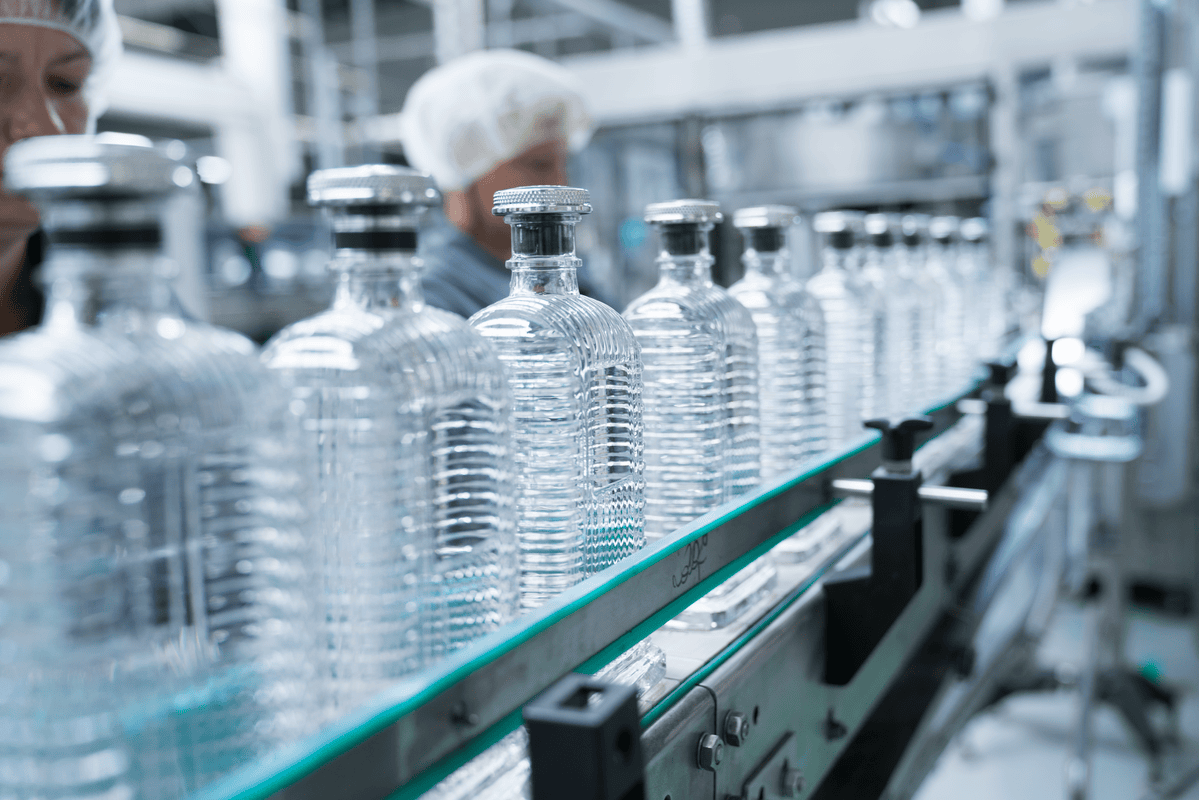
Glass is a classic and the most common choice for premium alcoholic beverages. Its main advantage is chemical inertness. There is no reaction between glass and vodka, it does not release any foreign substances and is completely impermeable to oxygen.
This means that the taste of vodka in glass remains the same as on the day it was bottled. There are no foreign notes, only the pure, uncontaminated composition intended by the manufacturer. That is why a glass bottle is considered the gold standard for storing high-quality vodka.
Plastic bottles
Plastic (PET, HDPE) is a polymer with a microporous structure. Even when standards are met, it allows ethanol vapours to pass through and organic compounds (e.g. acetaldehyde, ethanolamines) to migrate. This leads to:
– decreased softness in the initial sensation;
– the appearance of a barely perceptible “plastic” aftertaste;
– loss of the warmth that amber provides during the filtration process.
It is not harmful within the maximum permissible concentration, but it is a change in profile. This is unacceptable for vodka such as LEX, where each component is carefully selected.
Paper and combined solutions
Some producers are experimenting with eco-friendly alternatives, such as paper bottles or combined packaging. These solutions usually have an inner protective polymer or glass layer. Although the outer material — paper or cardboard — reduces the environmental footprint of the packaging, it is the inner layer that determines the impact of the packaging on the aroma of the vodka.
So far, this technology cannot guarantee the same level of protection as inert glass and is often considered a solution for single use or short-term storage.
How packaging preserves or alters the aroma of vodka
Even if a drink does not have a pronounced aroma, it can absorb foreign notes, especially during long-term storage. That is why it is important to understand the impact of packaging on the taste of vodka. How different types of containers behave when interacting with liquid: do they remain neutral or, on the contrary, add unwanted nuances?
The impact of glass on aroma
Glass creates an airtight environment that does not allow oxygen to enter and prevents volatile aromatic compounds from evaporating. In addition, dark glass (e.g., brown or green) effectively protects vodka from ultraviolet light, which can catalyse destructive chemical reactions. Thus, glass can be characterised as a neutral material — it adds nothing and takes nothing away, it only preserves.
The impact of plastic on aroma
Plastic, on the other hand, is an active material. Due to its porous structure, so-called “breathing” can occur – micro-penetration of oxygen inside and loss of volatile aromas outside. It is the primary reason why plastic has a negative effect on aroma. The second reason is the possibility of sorption, when aroma molecules literally stick to the inner walls of the bottle. As a result, the bouquet of vodka becomes less pronounced and simplified.
The taste of vodka in a glass as a benchmark for quality preservation
Glass containers are not just a tradition, but the result of a practical choice that has passed the test of time. Glass allows vodka to be preserved in the form in which it was created by technologists: without impurities, foreign odours or changes in taste. It is especially important for products where purity and neutrality are of paramount importance.
Unlike plastic or combined materials, glass does not react with alcohol, nor does it allow oxygen to pass through or release volatile compounds. Therefore, the difference between vodka in glass and plastic can be felt from the very first drops. For manufacturers, it is a guarantee of quality, and for consumers, it is confidence that the drink has remained exactly as it was intended.

The environmental aspect of choosing packaging for vodka
Undoubtedly, environmental issues are relevant today. Therefore, a logical question arises: which is better for storing vodka, glass or plastic, from an environmental perspective?
Glass is a material that is easily recycled and does not harm the environment. It can be reused, and after disposal, it can be turned into a new bottle without losing quality. Plastic, on the other hand, often ends up in landfills, where it decomposes for centuries.
Paper solutions look promising, but so far they do not provide the same level of protection as glass. Therefore, choosing glass containers is not only about the taste of vodka, but also about a responsible attitude towards nature.
Conclusions: does the material of the bottle affect the taste of vodka?
Yes, packaging can significantly alter the taste and aroma of vodka. Glass provides the best preservation of taste properties and is the benchmark for alcoholic beverages. Plastic and combined solutions are inferior in terms of stability and can affect the aroma and aftertaste. Therefore, if purity, predictability and stability of taste are important to the consumer, glass packaging is the best choice.
Visit the official Nemiroff website and learn about the unique technology used to manufacture perfume glass for premium beverages. It is the highest in terms of purity and transparency. Choose high-quality vodka and pay attention to the container — it makes a difference.